Making tax digital landlords need to know one thing above all else: which income threshold applies to them, and when. The rules are being rolled out in three phases based purely on how much you earn — not by when you register or what type of landlord you are. Here’s exactly how it works.
The three thresholds
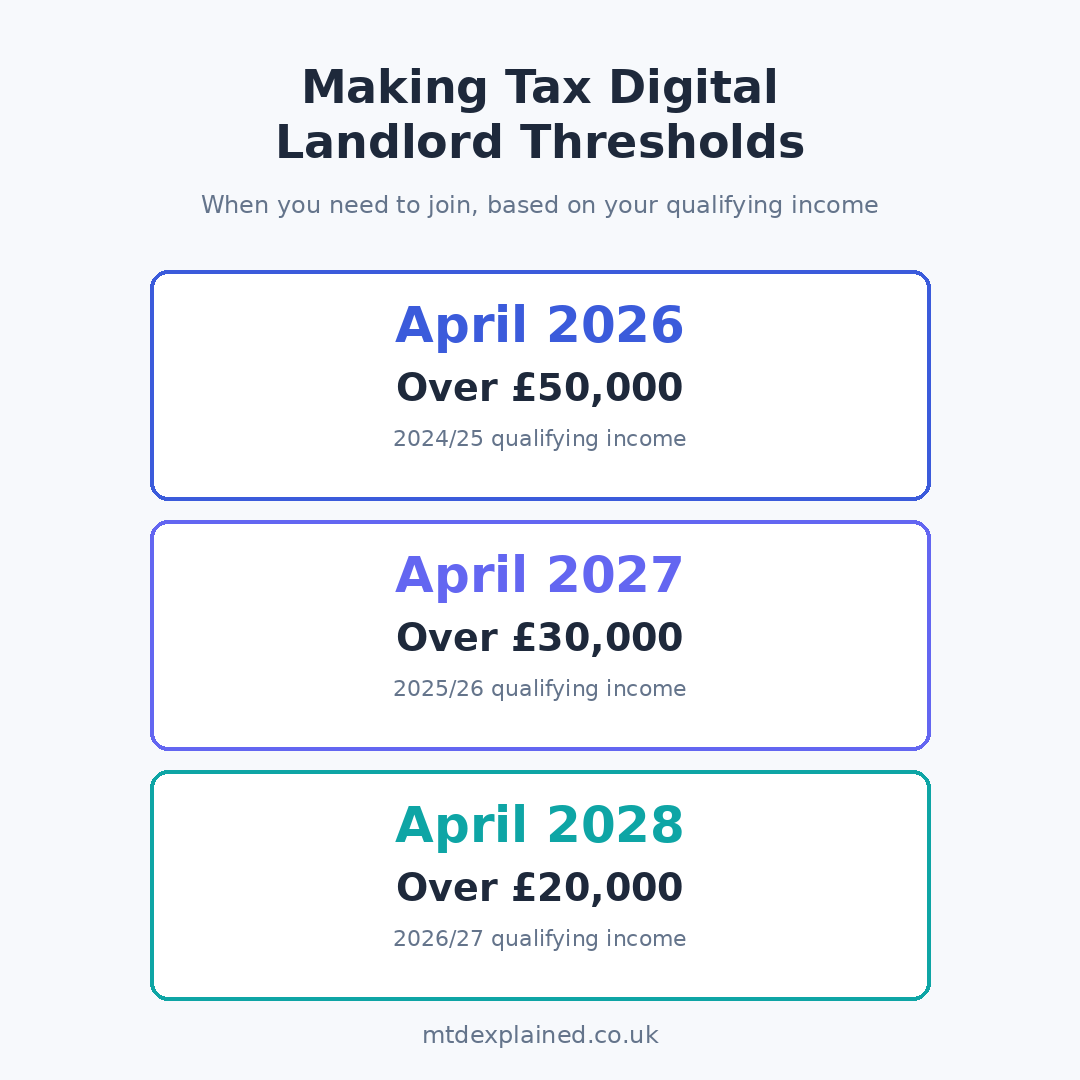
- From 6 April 2026 — if your gross income from self-employment and/or property was over £50,000 in the 2024/25 tax year, you need to join.
- From 6 April 2027 — the threshold drops to £30,000, based on your 2025/26 income.
- From 6 April 2028 — it drops again to £20,000, based on your 2026/27 income.
The key thing to understand: it’s your income in the relevant prior tax year that decides your start date, not your income right now. So if you’re currently under £50,000 but expect to cross £30,000 or £20,000 in future years, you’ll be brought in at that later phase — not before.
What counts towards the threshold?
Your “qualifying income” is the gross income (before expenses) from self-employment and property combined — not profit. So if you have both a rental property and a side business, HMRC adds the two together, not treated separately. Importantly, PAYE income, dividends, and pension income don’t count at all.
Jointly owned property?
Only your share of the rental income counts — not the total. So if you jointly own a property with your spouse and the total rent is £60,000, but you each receive £30,000, that’s what gets checked against the threshold — not the combined figure.
What if I’m not sure which phase applies to me?
Check your most recent filed tax return. If your gross income from self-employment/property was over £50,000 for 2024/25, you’re in from April 2026. If not, check again next year against the £30,000 threshold for 2025/26, and again the year after for £20,000.
Common questions from making tax digital landlords
What happens if I miss my MTD start date? If you’re required to join and don’t, HMRC can still expect quarterly updates from your mandatory start date — penalties are based on a new points system, with a fine issued once you accumulate four points for missed submissions. It’s worth setting up compatible software before your start date arrives, not after.
Do pensions or PAYE income count towards the threshold? No. Only income from self-employment and property (before expenses) counts. Employment income taxed under PAYE, pension income, and dividends are excluded entirely from the qualifying income calculation.
Can I join voluntarily before I’m required to? Yes — if your income is below the mandatory threshold, you can opt into Making Tax Digital voluntarily. Some landlords choose to do this to get used to the quarterly reporting process ahead of their actual mandatory start date.
What if my income changes partway through a tax year? Your start date is fixed based on a completed tax year’s income, checked once a year — a mid-year change in earnings doesn’t move your start date forward or back; it simply affects which threshold you’re measured against for the following year.
(This is general guidance, not personalised advice — if you’re unsure, HMRC’s own online checker or a qualified accountant can confirm your exact situation.)