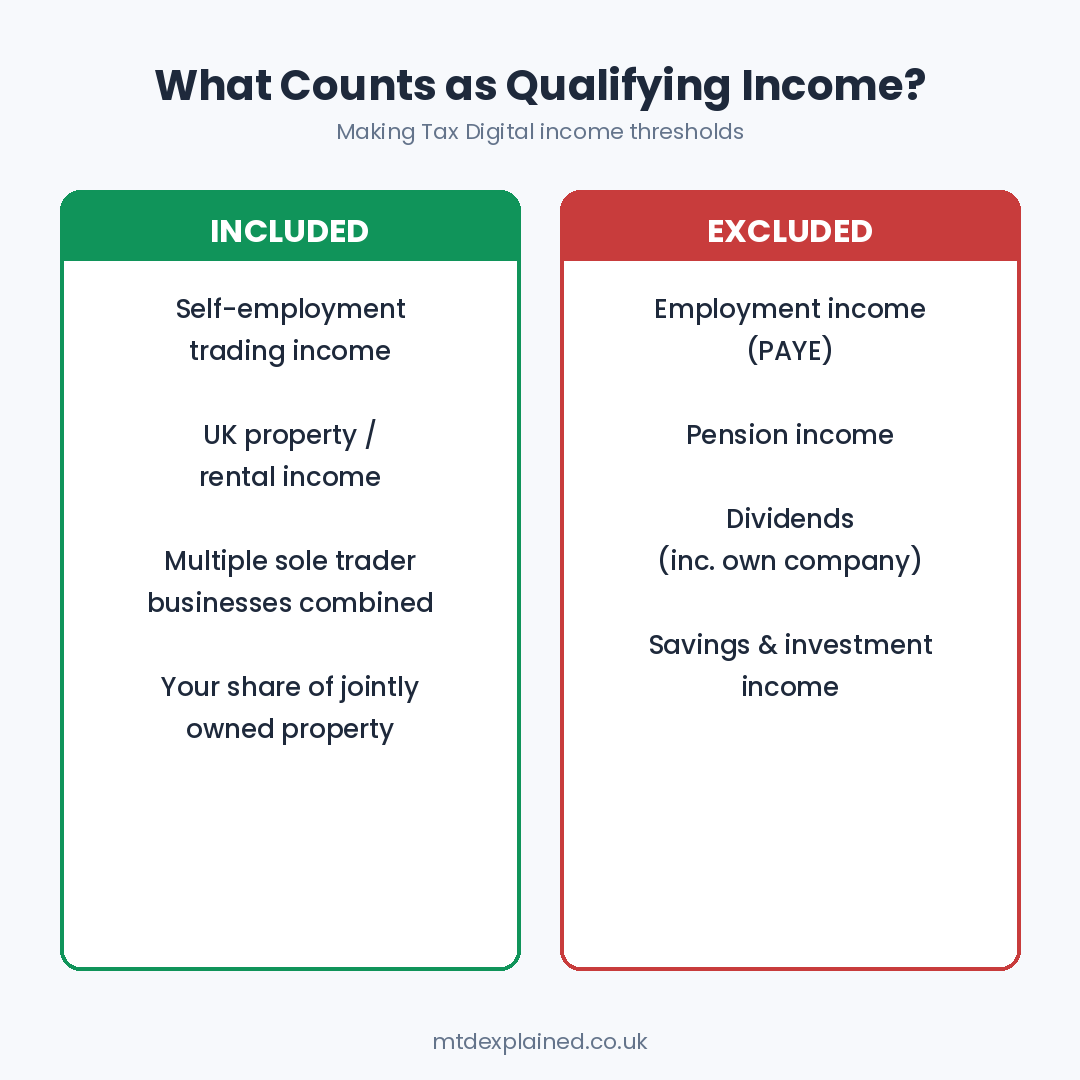
Making tax digital qualifying income is the single figure that decides whether — and when — you need to join MTD for Income Tax. Get this wrong and you could think you’re safely under the threshold when you’re not, or vice versa. Here’s exactly what counts, what doesn’t, and the details that catch people out.
The basic definition
Qualifying income is your gross income — before any expenses, allowances, or costs are deducted — from two sources combined:
- Self-employment income (sole trader trading income)
- UK property income (rental income from letting property)
HMRC adds these two together to get your total qualifying income, then checks that figure against the relevant threshold for the tax year.
It’s gross income, not profit
This is the point that trips up the most people. Your qualifying income is your turnover — the total money your business brought in — not what’s left after expenses, stock costs, mortgage interest, or any other deductions.
So a landlord with £45,000 in rent but only £20,000 left after mortgage interest and letting agent fees is still assessed on the £45,000 figure. A sole trader with £60,000 in sales but £25,000 profit after costs is assessed on the £60,000. Your actual tax bill is still based on your profit — but whether you need to join MTD at all is based on the gross figure.
What’s included
- Self-employment/sole trader trading income (gross, before expenses)
- UK property/rental income (gross, before expenses)
- Income from multiple sole trader businesses, added together
- Income from multiple rental properties, added together
- Your share of jointly owned property income (not the total — just your portion)
What’s excluded
- Employment income taxed under PAYE
- Pension income
- Dividends, including dividends from your own limited company
- Savings and investment income
- Foreign income that isn’t UK property (though foreign property income can count for UK residents — this gets more complex, so check your specific situation if this applies to you)
Combining self-employment and property income
If you’re both self-employed and a landlord, your two income sources are added together for the threshold test — even if neither one alone would put you over the limit. For example, £32,000 in self-employment income plus £22,000 in rental income gives combined qualifying income of £54,000, which is over the £50,000 Phase 1 threshold, even though neither figure alone reaches it.
Once you’re in MTD, though, each income source is reported separately — the combined figure only decides whether you’re in, not how you file once you are.
The £1,000 trading allowance — a genuine exception
If your total self-employment income is under £1,000, HMRC’s trading allowance means you don’t need to declare it on a Self Assessment return at all, and it falls outside MTD entirely. This is really only relevant for very small, occasional side income — and importantly, it doesn’t work as a way to reduce a larger figure. If your turnover is £52,000, you can’t subtract the £1,000 allowance to bring yourself under £50,000.
Which tax year’s income actually matters?
HMRC checks your qualifying income for a specific prior tax year to decide your start date:
- 2024/25 income determines whether you join from April 2026
- 2025/26 income determines whether you join from April 2027
- 2026/27 income determines whether you join from April 2028
Once your income for the relevant year is known (from your filed Self Assessment return), your start date is fixed — a change in your income the following year doesn’t move that start date, though it may affect a later threshold check if you weren’t caught by an earlier one.
(This is general guidance, not personalised advice — for anything specific to your situation, HMRC’s own online checker or a qualified accountant can confirm exactly how your income is assessed.)
Leave a Reply